



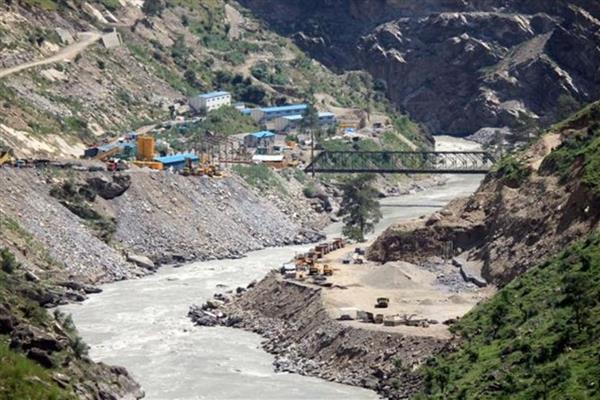
Srinagar, Jan 24 — As the Expert Appraisal Committee (EAC) of the Union Ministry of Environment, Forest and Climate Change extended the validity of the environmental clearance (EC) for the 850-MW Ratle Hydroelectric Project on the Chenab river till December 2030, The Himalayan Post explains how hydropower projects in Jammu and Kashmir are controlled, what royalty or free power means, and why the region exports electricity despite failing to meet its domestic demand.
Despite hosting several hydropower projects, Jammu and Kashmir continues to face electricity shortages, often leading to public protests and the recurring claim that the region “exports power while remaining in the dark”. The reasons lie in constitutional provisions, project ownership, seasonal generation patterns and power sale mechanisms.
Power lies in the Concurrent List
Electricity is placed in the Concurrent List of the Indian Constitution, allowing both the Union government and states or regions to legislate on the subject. In practice, however, large hydropower projects on interstate or strategically important rivers are developed and controlled by the Union government through central public sector undertakings such as NHPC.
This means that while power is generated in Jammu and Kashmir, decisions related to its sale and allocation are largely taken at the central level.
Who owns Kashmir’s power projects?
A significant share of hydropower capacity in the region is owned by NHPC, a Union government company. Electricity generated by these projects is sold through long-term Power Purchase Agreements (PPAs) to distribution utilities across the country.
As a result, much of the electricity produced in Kashmir flows into the national grid rather than being reserved exclusively for local consumption.
Seasonal mismatch in generation and demand
Most hydropower projects in Kashmir are run-of-the-river schemes, which generate peak power during summer months when river flows are high. In winter, when electricity demand rises sharply due to heating needs, water levels drop, leading to reduced generation.
To meet winter demand, Jammu and Kashmir has to purchase power from outside the region, often at higher market rates.
Locals frequently protest that the region “owes electricity” despite hosting multiple power projects.
The Himalayan Post has earlier reported, citing energy experts, that Jammu and Kashmir could meet much of its local power demand by prioritising small and medium hydropower projects, reducing dependence on large centralised projects with limited local control.
What is royalty or free power?
Officials point out that host regions are entitled to a share of electricity as royalty, commonly referred to as free power. Hydropower projects are mandated to provide a fixed percentage of electricity to the host administration at no cost, a share that can increase over time.
This free power is meant to compensate for land acquisition, environmental impact and local inconvenience. How effectively it translates into tangible benefits for consumers, however, remains a subject of debate.
Environmental concerns in Chenab basin
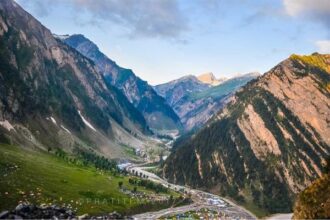
The extension of environmental clearance also comes amid long-standing concerns about the Chenab river basin, which already houses multiple hydropower projects. Geological studies, including research by Banaras Hindu University, have described the region as highly seismically sensitive.
According to the study, the Chenab valley lies between the rupture zones of the Panjal Thrust and the Kishtwar Window, making it prone to seismic activity. The region has witnessed intense folding and faulting due to ongoing Himalayan orogeny, with rocks of the Lesser Himalaya exposed as thrust sheets following the collision of the Indian and Eurasian plates around 50 million years ago.
Experts have warned that cumulative construction activity in such fragile terrain could increase environmental and geological risks.
The paradox of power-rich rivers and local shortages is the result of constitutional arrangements, central ownership of projects, seasonal hydrology and limited local control. Until structural changes are made in power allocation, storage capacity or project design, the gap between electricity generation and local availability is likely to persist.