Like Wuthering Heights and Thrushcross Grange, which do more than describe places—they capture the people, emotions, and life within them—Kashmir’s geography speaks in its own voice.
Traveling from Sonmarg toward the mighty Zojila—the steep, imposing pass that divides regions and acts as a natural boundary—the landscape shifts in ways that are almost literary. The mountains of the Kashmir Valley, with their soft green slopes and endless rows of conifers, feel like an embrace.
When we sit in Sonmarg’s lap, surrounded by this lush green, a lone stony mountain rises among the softer peaks. Its bare, jagged face seems almost to declare, “Behind me lies Gilgit-Baltistan.” Geography here becomes more than backdrop—it speaks, hints at what lies beyond, and reminds us of borders that are as much imagined as real. The Valley’s embrace softens, yet the mountains whisper of the lands beyond, of terrains that demand endurance and carry stories different from our own.
But as we cross Zojila, the mountains shed their gentleness. They become bare, stony, sharp, and unforgiving. Sometimes muddy, sometimes jagged, they demand attention. A river runs parallel to the highway, mending its own path, as if saying to travelers: “Follow me, and I will show you another side of civilization.”
The moors in Wuthering Heights are Kashmir’s Zojila. Just as Brontë’s windswept, stormy moors mirror the tumult of her characters’ emotions, Zojila’s stark expanse evokes awe, challenge, and reflection. Its air feels sharper, wider, calmer than the cozy intimacy of the Valley.
Kargil, though still bearing signs of the Valley’s influence, gives way to Ladakh, which feels like a different world entirely—a land etched in shades of brown and stone. Crossing Zojila is a transition: the green of the Kashmir Valley thins, the air sharpens, and mountains lose their softness. What emerges is exposed, almost raw. Kargil’s rocky stretches and barren ridges do not invite you in; they confront you. They demand endurance rather than offering comfort.
Looking at it poetically—or politically—offers insight. The Valley nurtures memory and intimacy, while Kargil and Ladakh demand survival. The contrast between the lush Valley and the high-altitude passes is not merely visual; it is emotional. One encourages reflection, the other tests resilience. Landscape, here, becomes psychological.
A similar geography emerges when visiting the Gurez Valley, moving toward Tulail. Though largely inaccessible to the public, satellite maps suggest a hidden passage, a thread of connection leading all the way to Leh. Here too, the landscape transitions—lush valleys giving way to steeper, raw ridges, the sense of distance and separation magnified.
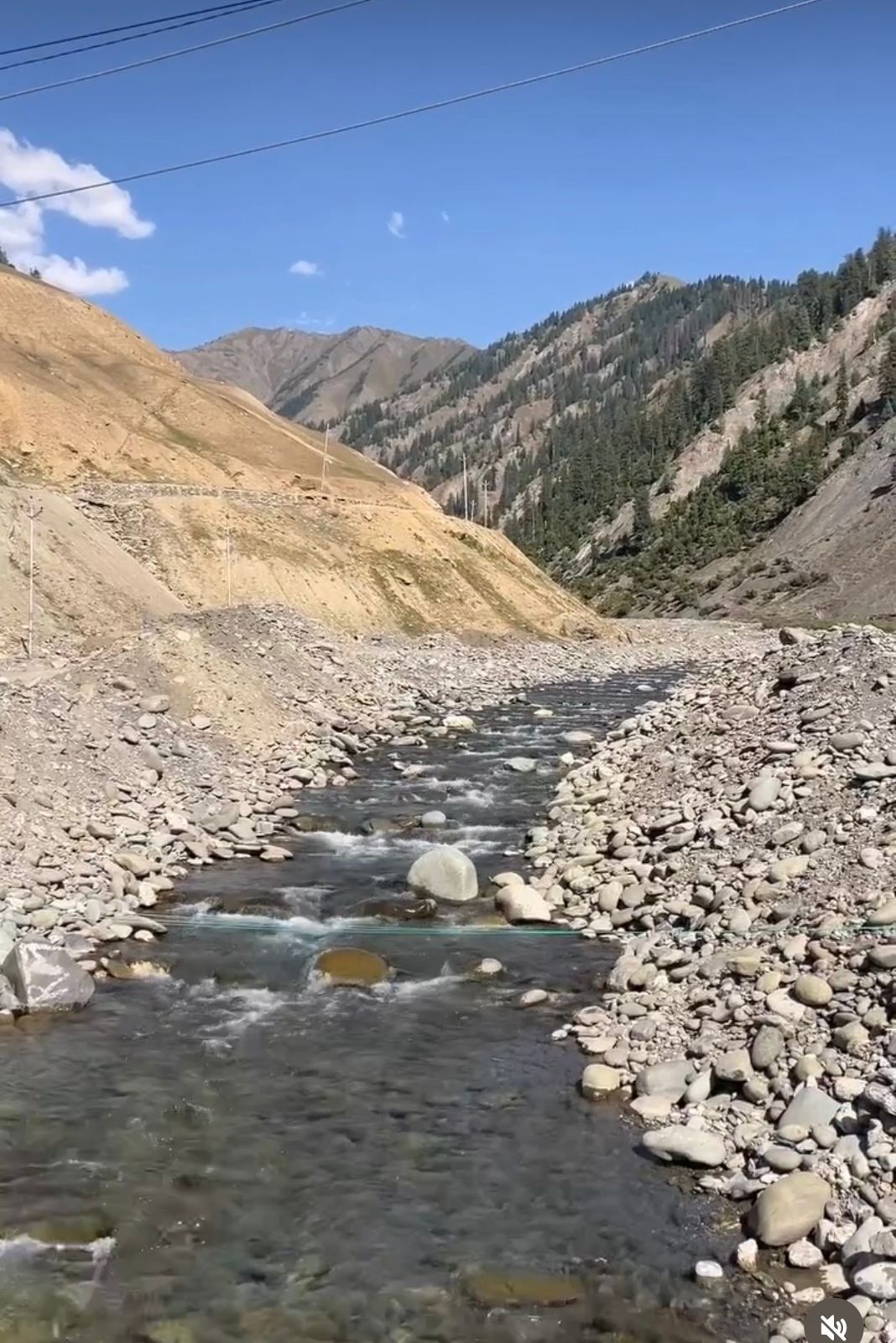 Stark transition from Kashmir’s lush Valley to the harsher terrain of Ladakh in Tulail.
Geography, once again, is a living guide: it shows what is reachable, hints at journeys possible, and frames the boundaries of human experience in its stark, beautiful contours.
This interplay between land and identity is not unique to Kashmir. In literature, geography often carries the weight of human emotion. In Wuthering Heights, Emily Brontë constructs two worlds—the wild, stormy moors and the refined Thrushcross Grange—to mirror her characters’ inner turmoil. The moors are not merely setting; they are emotion made visible. Similarly, Kashmir’s geography embodies a spectrum of human experience: intimacy, struggle, endurance, and longing.
The Valley is memory: lush, layered, deeply rooted. It holds stories, relationships, and continuity. Beyond it, the harsher terrain strips away pretense. What remains there is elemental. Perhaps that is why journeys across these landscapes feel so personal—they are movements across distance and states of being. You leave one version of yourself behind and arrive, subtly transformed, in another.
The land also reflects choices—those of its people, its rulers, its history—and the consequences that have shaped its present. Once part of a larger whole, Kashmir now exists in a space apart. To grow up here is to carry both geographies within oneself: the Valley’s softness and the mountains’ severity. One teaches feeling, the other endurance.
Identity, like landscape, is never singular. It is shaped by contrasts, by crossings, and by the spaces in between. In the end, the land does not merely define where we are—it shapes who we become.