



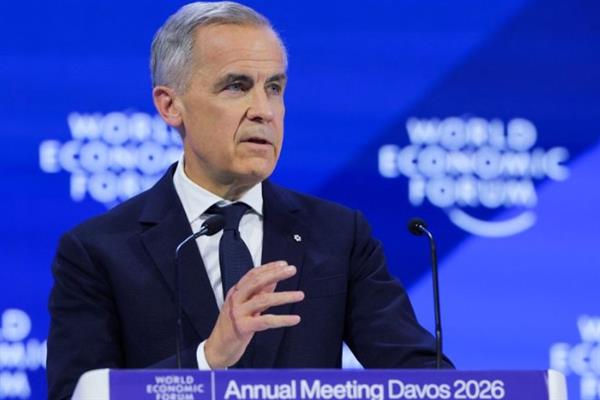
Davos, Jan 21— Canadian Prime Minister Mark Carney on Tuesday warned that the world is witnessing a fundamental rupture in the global order, not a gradual transition, as great power rivalry deepens and economic tools are increasingly used as instruments of coercion.
Addressing the 56th annual World Economic Forum summit, Carney cautioned against the weaponisation of trade, finance and supply chains, arguing that such practices threaten sovereignty, stability and long-term prosperity. “Today, I will talk about a rupture in the world order—the end of a pleasant fiction and the beginning of a harsh reality, where major geopolitical powers operate with few limits and constraints,” he said.
Without naming Washington directly, Carney criticised tariff coercion and measures linked to Greenland, urging dialogue and cooperation instead. “Countries like Canada have the capacity to help build a new order that reflects our values, including respect for human rights, sustainable development, solidarity, sovereignty and territorial integrity,” he said.
Carney said the era of a stable, rules-based international system had given way to a tougher geopolitical landscape. “Every day, it seems we are living in an era of great power rivalry, where the rules-based order is fading, the strong do what they can, and the weak suffer what they must,” he said, stressing that the world was facing “a rupture, not a transition.”
He acknowledged that the existing international system was never perfect and that powerful states, including the United States, often bent or ignored rules when it suited them. Yet, he argued, the framework still delivered critical global public goods. “This fiction was nevertheless useful. American hegemony helped provide public goods—open sea lanes, a stable financial system, collective security, and frameworks for resolving disputes,” Carney said.
“That bargain no longer works,” he added, warning that economic integration is now frequently used to exert pressure on sovereign states. Tariffs, financial infrastructure and supply chain dependencies, he said, are undermining the idea of mutual benefit that once underpinned globalisation.
Carney cautioned that a retreat into protectionism and economic fortresses would leave the world poorer and more fragile, even as he acknowledged why many countries are seeking greater strategic autonomy. “When rules do not protect you, you must protect yourself,” he said, adding that isolation and unilateralism were not viable long-term answers.
“If great powers abandon even the pretence of rules and values in pursuit of unchecked power, the gains from globalisation will be far harder to replicate,” he said, noting that allies would increasingly diversify partnerships to hedge against uncertainty.
Calling for cooperation over confrontation, Carney argued that the costs of strategic autonomy and sovereignty could be shared through common standards and complementary economic ties. “The question is whether we respond by building higher walls or by pursuing something more ambitious,” he said.
He said Canada is diversifying its economic partnerships and pursuing trade agreements with India, ASEAN, Thailand, the Philippines and the Mercosur bloc, while reaffirming Ottawa’s commitment to multilateralism. “Unchecked power politics will only deepen global instability,” Carney warned, pledging to work with like-minded partners to defend sovereignty, territorial integrity and sustainable development.